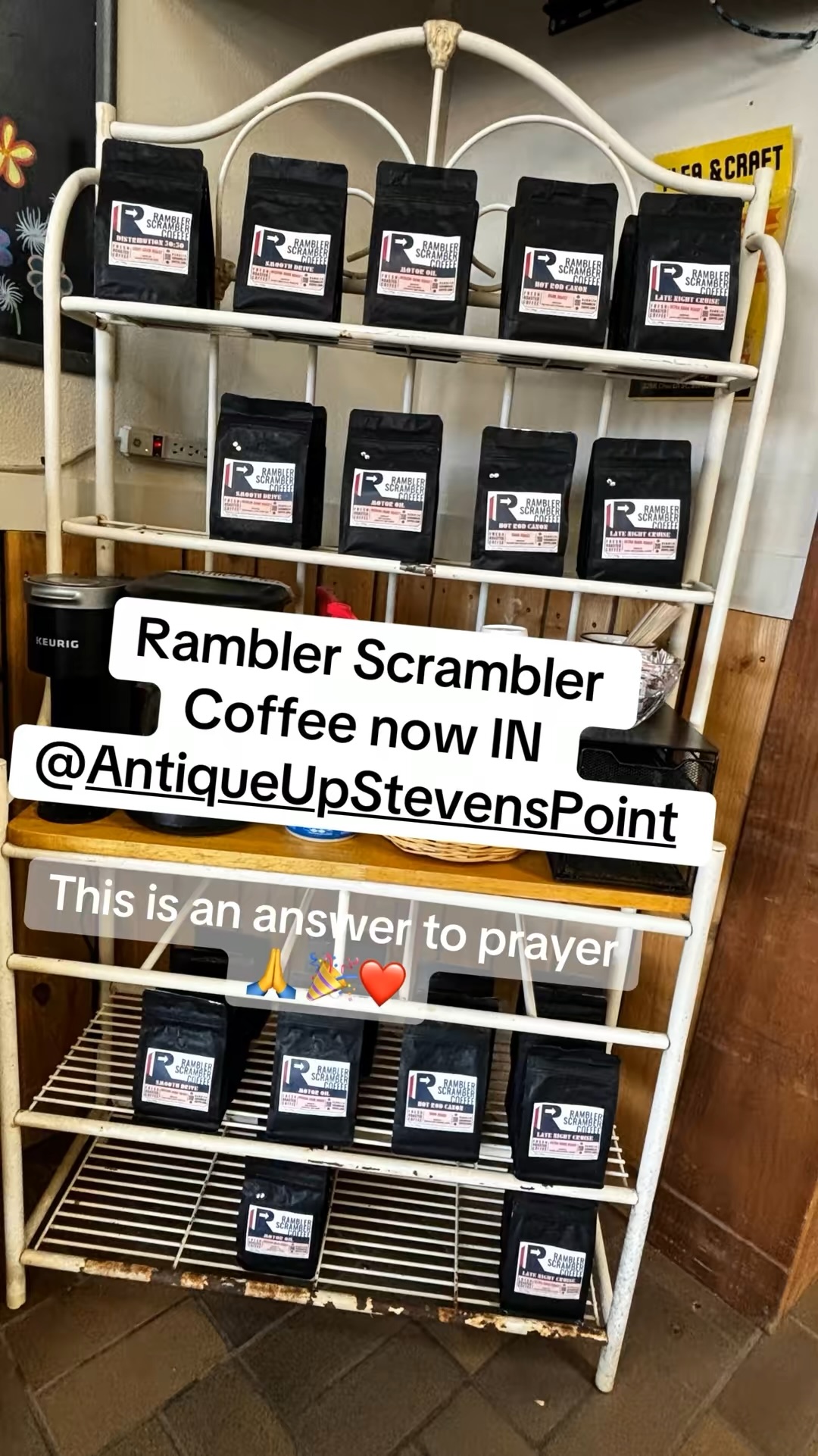
Rambler Scrambler Coffee has had the privilege to become a vendor at Antique Up in Stevens Point, WI! It’s all God’s doing and such an answer to prayer!
The AMC SC/Rambler Scrambler, known for its distinctive styling and performance, was a response to the growing muscle car market in the late 1960s. Its unique ‘scrambler’ stripes and aggressive stance made it stand out on the road. Additionally, the SC/Rambler Scrambler was marketed as a ‘fun car’ for young enthusiasts, embodying the spirit of freedom and adventure. What adventures have you had with your favorite muscle car?
Not all muscle came out of Detroit. This AMC Hurst “Scrambler” was birthed out of Kenosha, Wisconsin. Looking equally sharp and patriotic in the Type B paint scheme.
Walk down the coffee aisle and you’ll see the word bold everywhere.
Bold roast. Bold flavor. Bold blend.
Then there’s “strong,” “dark,” “rich,” and occasionally enough coffee terminology to make you wonder whether you need a certification before you’re allowed to make breakfast.
You don’t.
But there is one useful thing to know: bold, strong and dark don’t necessarily mean the same thing.
Understanding the difference can make it much easier to find the coffee you actually enjoy.
What Is Bold Coffee?
Here’s where things get interesting: “bold” isn’t a precise measurement like temperature or weight.
When someone describes coffee as bold, they’re usually talking about the overall impression the coffee makes.
It might have:
A fuller, heavier flavor
A substantial mouthfeel
Roasted, chocolatey or smoky characteristics
Flavors that remain noticeable after adding cream
A lingering finish
In ordinary language, bold coffee tends to be coffee that doesn’t quietly disappear in the background.
But that doesn’t necessarily make it strong.
Bold Coffee vs. Strong Coffee
This distinction is probably the most useful one.
Strength is heavily influenced by how you brew the coffee.
Use more ground coffee with the same amount of water, and you’ll generally make a stronger cup. Use less coffee with the same amount of water, and you’ll make a weaker one.
Coffee professionals call this the brew ratio: the relationship between the amount of coffee grounds and the amount of brewing water.
You don’t need to start weighing everything in your kitchen to understand the concept.
Think of lemonade.
If you add a little lemonade concentrate to a large glass of water, it’s weak. Add considerably more concentrate to that same glass, and it’s strong.
Coffee works on a similar principle.
That means you can take a relatively light roast and brew it strong.
You can also take a very dark roast and brew it weak.
Roast level and brew strength are two different controls.
So What Does Dark Roast Mean?
Now we’re talking about the roasting process rather than your brewing recipe.
Green coffee beans change dramatically as they’re heated. The roasting process develops the aromas, flavors and colors we associate with coffee.
Generally speaking, lighter roasting preserves more characteristics associated with the coffee itself, while progressively darker roasting creates more pronounced roast-derived flavors.
That is one reason darker coffees may be described as smoky, roasty, bittersweet or intense.
Our coffee source specifically selects coffees for qualities including clarity, balance and natural sweetness and uses a precision-controlled hot-air roasting system designed to produce consistent batches.
That consistency matters.
You shouldn’t have to wonder whether the coffee you enjoyed last time is going to taste completely different when you order it again.
And What Is “Body”?
Here’s another coffee term that’s actually useful once somebody explains it.
Body is essentially how substantial the coffee feels in your mouth.
Think about the difference between skim milk and whole milk.
Both are milk, but they don’t feel the same when you drink them.
Coffee can have a lighter, tea-like body or a heavier, fuller body.
Body isn’t exactly the same thing as flavor intensity, but the two can contribute to your overall perception of a coffee as “bold.”
Does Bold Mean Bitter?
Definitely not.
Bitterness is a normal component of coffee, but an unpleasantly bitter cup can have several causes.
Roast level can influence bitterness, but so can brewing.
Water temperature, grind size, brew time and extraction all affect what ends up in your cup.
Extraction is simply the process of water pulling soluble compounds out of ground coffee.
That’s it.
No lab coat required.
If the brewing process pulls an undesirable balance of compounds from the grounds, your coffee may taste harsh or unpleasant. Changing the brewing method can sometimes make a substantial difference without changing the coffee at all.
What Should You Buy If You Say, “I Like Strong Coffee”?
This is the question I’d ask next:
What do you mean by strong?
If you want deep roasted flavors that stand up to cream, you’re probably describing a preference for a darker, bolder coffee.
If you enjoy your current coffee but wish it packed more punch, you may simply need to adjust how much coffee you’re using.
If you want something substantial without pronounced dark-roast characteristics, you might prefer a medium roast with good body.
And if “strong” means “I need caffeine immediately because somebody scheduled a 7 a.m. meeting,” that’s another question entirely.
The important part is this:
You don’t have to know coffee terminology to know what tastes good to you.
Coffee terminology is supposed to help us describe what we’re tasting—not turn drinking coffee into an entrance exam.
So next time somebody asks whether you like your coffee bold, strong or dark, you’ll know there actually is a difference.
And if you’d still rather answer, “Just give me something that tastes like coffee,” we respect that too.
The short answer: Bold coffee generally describes a coffee with an intense, noticeable flavor. Strong coffee describes how concentrated the brewed coffee is, while dark roast describes how far the beans were roasted. A coffee can be bold without being brewed strong—and strong coffee doesn’t necessarily have to be dark.
Coffee feels timeless now. It sits on kitchen counters, diner tables, workbenches, and gas station dashboards like it has always belonged there. But coffee did not begin as the everyday drink we know today. Its story starts with a plant native to Ethiopia, travels through Yemen and the wider Islamic world, then moves into Europe, Britain, and the Americas until it becomes one of the world’s most influential drinks. The exact beginning is still partly mysterious, but historians broadly agree on the path: wild coffee is linked to Ethiopia, while coffee as a brewed beverage took shape in Yemen and spread outward through trade, religion, and social life.
One of the best-known stories about coffee’s discovery is the legend of Kaldi, a goatherd in Ethiopia who noticed his goats becoming unusually energetic after eating coffee cherries. It is a memorable story, but it should be treated as legend, not hard proof. What matters more is that coffee plants were associated with the Ethiopian plateau, and at some point, likely by the 15th century, coffee plants were taken across the Red Sea to southern Arabia, especially Yemen, where they were cultivated intentionally. That shift matters because it marks the point where coffee moved from a regional plant into a managed crop with cultural and economic significance.
Yemen is where coffee began to look more like the drink history remembers. Traditions recorded by major reference works hold that Sufi monks were among the first to brew coffee as a drink and use it to stay awake through night prayers. From there, coffee’s stimulating effect made it useful far beyond religious practice. It became a social beverage, then a commercial one. The port of Mocha in Yemen became deeply tied to the coffee trade, so much so that the word “mocha” still carries that history today. Coffee was no longer just a berry or a local custom. It had become a product, a ritual, and a portable habit.
As coffee spread through the Arabian Peninsula and the Ottoman world, coffeehouses emerged as something bigger than places to get a drink. In Mecca in the 15th century and Constantinople in the 16th, coffeehouses became gathering places where people could talk, play games, listen to music, hear news, and discuss politics and ideas. The National Coffee Association describes these places as thriving public hubs, and Britannica notes that they became important meeting places for learning and conversation. That is one of the most important turns in coffee history: people did not just drink coffee for energy. They drank it together. Coffee became tied to conversation, public life, and community.
When coffee reached Europe in the 17th century, it did more than introduce a new taste. It helped reshape public culture. Coffeehouses spread across the continent and became places where merchants, writers, thinkers, and ordinary citizens exchanged ideas. In Britain, coffeehouses became so influential that they were nicknamed “Penny Universities,” because for the price of admission and a cup of coffee, a person could enter a room full of information, debate, and opportunity. Royal Museums Greenwich notes that these coffeehouses helped circulate news quickly and even played a role in business history, with Lloyd’s of London tracing its beginnings to Lloyd’s Coffee House. Coffee was becoming linked not only to alertness, but to trade, discussion, and modern public life.
Coffee’s rise in the American colonies carried its own meaning. In the early 1700s, tea was still strongly associated with British identity, but that began to change during the American Revolution. According to the White House Historical Association, coffee gained cultural force as colonists increasingly turned away from tea and toward coffeehouses, using coffee as part of a broader shift in political and social identity. That detail is worth noticing because it shows coffee was never only about flavor. From the Islamic world to Europe to early America, coffee has repeatedly become a symbol of shared habits, changing values, and new forms of public life.
So how did people start drinking coffee? Not in one dramatic moment, and not for one single reason. Some drank it for religious devotion, some for its stimulating effect, some for trade, and many because it created a place to gather. That is why coffee endured. It answered several human needs at once: energy, ritual, hospitality, and conversation. Long before modern cafes and morning commutes, coffee was already doing what it still does now. It gave people a reason to pause, talk, think, and begin the day with purpose.